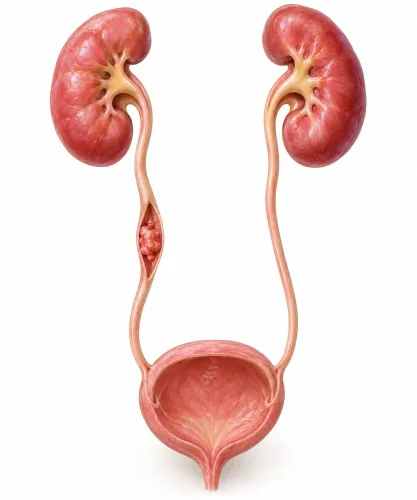
A stone lodged in the urethra can cause sudden pain, difficulty passing urine, a weak or interrupted stream and sometimes urinary retention. However, similar symptoms can occur with urethral stricture, prostate-related obstruction, infection or bladder dysfunction.
The important step is to identify the actual cause of the obstruction before deciding whether observation, medication, endoscopic treatment or another intervention is appropriate.
What Are Urethral Stones?
Urethral stones are stones located within the urethra, the passage through which urine leaves the bladder.
They may represent a stone that has travelled down from the urinary tract or, less commonly, a stone that has formed in association with an underlying abnormality of the lower urinary tract.
A stone may become lodged where the urethral passage is relatively narrow or where an underlying narrowing or abnormality is present.
The severity of symptoms depends on the stone's size and location, the degree of obstruction and the condition of the urinary tract.
What Symptoms Can Urethral Stones Cause?
Possible symptoms include:
- Sudden or severe pain while passing urine
- Burning or discomfort during urination
- Weak or interrupted urine flow
- Difficulty starting urination
- A sensation of something blocking the urinary passage
- Pain along the urethra or penis
- Blood in the urine
- Difficulty emptying the bladder
- Increasing lower abdominal discomfort
- Inability to pass urine
Symptoms can develop suddenly, particularly if a stone becomes impacted and obstructs the urethral passage.
However, these symptoms are not specific to urethral stones.
A Weak Urine Stream Is Not Always a Stone
Difficulty passing urine has several possible causes.
These may include:
- Urethral stricture
- Enlarged prostate or bladder outlet obstruction
- Urinary tract infection or inflammation
- Bladder dysfunction
- Neurological conditions affecting bladder emptying
- Urinary stones
- Previous urethral instrumentation or trauma
- Other causes of urinary obstruction
The American Urological Association recommends considering urethral stricture in men presenting with a decreased urinary stream, incomplete emptying, dysuria, urinary infection or increasing post-void residual urine.
This is why a sudden or persistent change in urinary flow should not automatically be attributed to a stone.
When Should You See a Urologist?
A urological assessment is appropriate when urinary difficulty is:
- New or persistent
- Repeatedly interrupting the urine stream
- Associated with pain or burning
- Associated with blood in the urine
- Accompanied by a sensation of incomplete emptying
- Associated with previous urinary stones
- Occurring after previous urethral surgery, instrumentation or trauma
- Becoming progressively worse
The evaluation should focus on identifying why the urine flow has changed, rather than assuming that a stone is responsible.
How Is a Urethral Stone Diagnosed?
Diagnosis begins with a detailed history and physical examination.
The urologist may assess:
- When the symptoms started
- Whether the onset was sudden or gradual
- Previous urinary stone disease
- Previous catheterisation or urethral procedures
- History of urethral injury
- Previous urinary infections
- Prostate-related urinary symptoms
- Whether urine is still passing
- Previous episodes of urinary retention
Depending on the findings, investigations may include:
Urine Testing
Urine testing may be appropriate when infection, inflammation or blood in the urine is suspected.
Assessment of Bladder Emptying
Measurement of post-void residual urine can help determine whether the bladder is emptying adequately.
Uroflowmetry may also provide useful information about urinary flow in selected patients.
Imaging
Ultrasound or other imaging may be considered depending on the suspected location of the stone and the clinical circumstances.
For suspected renal or ureteric stone disease presenting as renal colic, NICE recommends urgent low-dose non-contrast CT in adults, usually within 24 hours. However, the imaging strategy for a suspected urethral stone is individualised according to the clinical findings and suspected location.
Examination of the Urethra
When urethral obstruction or stricture is suspected, direct assessment of the urethra may be required.
Depending on the situation, this can include urethroscopy/cystoscopy or appropriate urethrographic imaging.
The EAU's current urethral-stricture guidance emphasises structured diagnostic evaluation and has been comprehensively updated for 2026.
Does Every Urethral Stone Need a Procedure?
No.
Management depends on:
- Stone size
- Stone location
- Degree of obstruction
- Symptoms
- Whether the stone is likely to pass safely
- Presence of infection
- Presence of urinary retention
- Condition of the urethra
- Any underlying narrowing or obstruction
A small stone that is moving and not causing significant obstruction may sometimes be managed conservatively under medical supervision.
An impacted stone causing significant obstruction, persistent symptoms or urinary retention may require removal.
Depending on the location and clinical circumstances, treatment may involve an endoscopic procedure to remove or fragment the stone.
The exact procedure should be selected after the location of the stone and condition of the urethra have been established.
What If There Is an Underlying Urethral Stricture?
This is an important consideration.
A urethral stone may coexist with an abnormal narrowing of the urethra. If a stricture is responsible for impaired urine flow, simply treating a stone may not resolve the underlying problem.
The EAU and AUA guidelines provide specific approaches to diagnosing and managing urethral stricture disease.
Therefore, when symptoms suggest persistent obstruction, the urologist may need to evaluate the urethra itself rather than focusing only on the stone.
What Should You Not Do?
A suspected urethral stone should not be forcibly manipulated or pushed out without appropriate medical assessment.
Attempts to manipulate an impacted stone can potentially injure the urethral lining and may worsen bleeding, inflammation or obstruction.
Similarly, repeatedly taking medicines to improve urine flow without establishing the cause may delay appropriate treatment.
When Is It an Emergency?
Seek urgent medical attention if you develop:
- Complete inability to pass urine
- Severe or rapidly increasing pain
- Increasing lower abdominal pressure
- Markedly reduced urine output
- Significant bleeding
- Fever or chills associated with urinary obstruction
- Severe weakness or feeling acutely unwell
Complete urinary retention may require prompt bladder drainage and treatment of the underlying cause.
Fever or systemic symptoms in the presence of urinary obstruction are particularly concerning because infection combined with obstruction can require urgent treatment.
NICE specifically notes that an infected obstructed urinary system requires urgent management and is outside the routine renal/ureteric stone pathway.
Can a Urethral Stone Be Prevented?
Prevention depends partly on where the stone originated and why it formed.
Patients with recurrent urinary stones may require assessment for stone composition and metabolic risk factors. General stone-prevention measures include maintaining adequate fluid intake and addressing relevant dietary or metabolic risk factors.
The EAU recommends generous fluid intake for urinary stone formers, with a target urine volume above 2.5 litres per day where clinically appropriate.
However, patients with a urethral stone should not assume that increasing fluids alone will remove an impacted stone causing obstruction.
Local Urological Evaluation in Govandi
Difficulty passing urine can be caused by several conditions, and the correct treatment depends on identifying the underlying problem.
For patients in Govandi and surrounding areas of Mumbai, Dr Zaffar K. Sayed provides urological evaluation for urinary obstruction, urinary stones, urethral conditions and related male urinary problems.
Assessment may include clinical examination and appropriate investigations to determine whether the symptoms are related to a stone, urethral narrowing, prostate-related obstruction, infection or another urinary condition.
Key Message
A sudden change in urinary flow should not automatically be assumed to be a urethral stone.
A stone can obstruct the urethra, but urethral stricture, prostate enlargement, infection and bladder dysfunction can produce similar symptoms.
The priority is to establish the cause of the obstruction and then select the safest and most appropriate treatment.
Complete inability to urinate, severe pain, significant bleeding, or fever associated with urinary obstruction requires prompt medical assessment.
Keywords