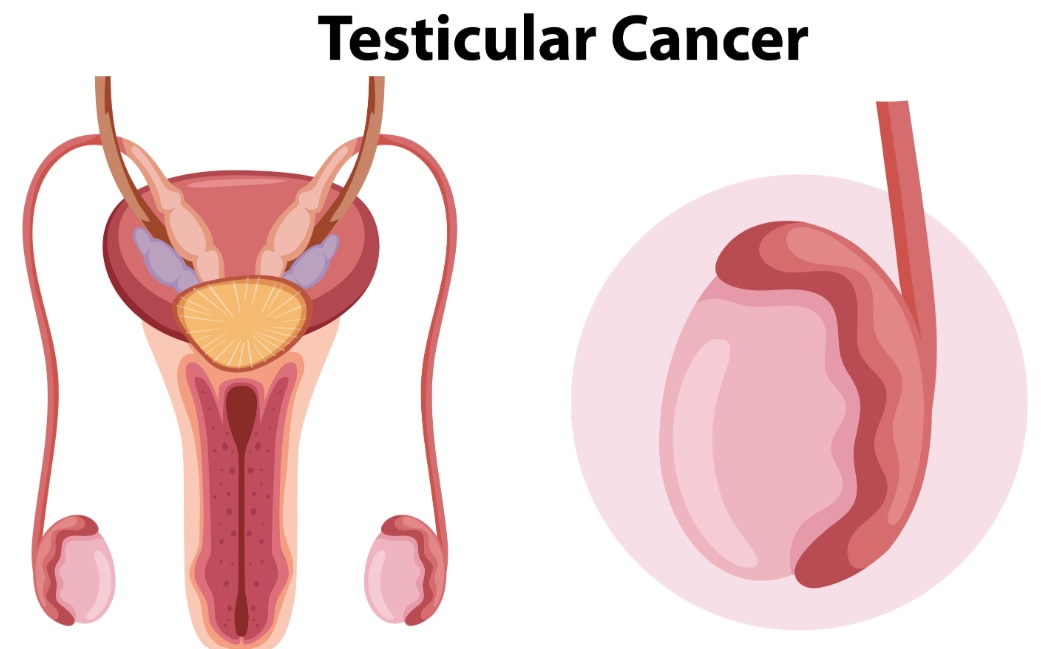
Arrange a medical assessment for any new testicular lump, firm area, enlargement, change in shape or swelling that does not quickly resolve, even when it is painless. By separating emergency warning signs from problems suitable for a prompt appointment, you can act quickly without assuming that every scrotal lump is cancer.
Key takeaways
- Arrange assessment within days for any new testicular lump or persistent swelling.
- Seek same-day emergency care for sudden severe pain, nausea, or a high-riding testicle.
- Do not rely on pain, self-examination, or waiting to see whether a lump disappears.
- An ultrasound scan helps distinguish testicular cancer from other causes of swelling.
When a Testicular Lump Needs Prompt Assessment
Arrange a clinical assessment promptly—ideally within days, not weeks—for any new testicular lump, hard lump in the testicle, enlargement, change in shape or persistent testicular swelling. Do not wait for pain or assume the change will disappear.
A painless testicular lump is not reassuring. Testicular cancer often causes a painless lump or swelling, while pain, tenderness or heaviness does not rule it out. A painful swelling still needs examination rather than being labelled an infection without assessment.
Age does not make a new change safe to ignore. Testicular cancer is most common in males aged about 15–40, but it can occur outside that range. Arrange assessment sooner if you have had an undescended testicle, previous testicular cancer or a first-degree relative with it; many affected men have no known risk factor.
Go to emergency care immediately for:
- Sudden, severe testicular pain, especially with nausea, vomiting, abdominal pain or a high-riding testicle
- Rapid swelling with redness or fever
- Severe pain after an injury
These signs can indicate torsion, infection or serious trauma. Torsion can cut off blood supply, and the best chance of saving the testicle is within about four to six hours. Do not wait for a routine appointment, even if the pain temporarily improves.
Which Scrotal Symptoms Need Same-Day Emergency Care?
Go to emergency care now for sudden severe testicular pain, especially with testicular pain with nausea and vomiting, abdominal pain, a high-riding testicle, or a testicle sitting at an unusual angle.
Treat this pattern as a testicular torsion emergency: twisting can stop blood flow, and the best chance of saving the testicle is within about 4–6 hours.
| Symptom | Why it needs same-day care | What to do |
|---|---|---|
| Sudden severe pain or a high-riding, twisted testicle | Torsion can destroy the testicle as blood supply falls | Go to the emergency department immediately |
| Pain with nausea, vomiting or abdominal pain | These symptoms commonly accompany torsion | Do not wait for a routine urology appointment |
| Fever, increasing redness, warmth or marked tenderness | Infection can spread and damage the testicle | Seek same-day assessment for examination and testing |
| Scrotal pain or swelling after a significant injury | Bleeding or rupture cannot be ruled out at home | Attend emergency care, especially if pain is severe |
Do not dismiss torsion because the pain improves. Intermittent torsion can untwist temporarily and then recur, so it still needs urgent assessment.
A painless lump does not usually require emergency care, but arrange prompt clinical review rather than watching it indefinitely. Testicular cancer often causes a painless lump or enlargement, and the absence of pain does not make a new change safe to ignore.
What Else Can Cause a Lump or Swollen Testicle?
A new firm area within the testicle needs prompt examination, even if it does not hurt. Comparing testicular cancer versus epididymal cyst by touch is unreliable; a clinician and usually an ultrasound must identify where the swelling begins.
| Cause | Typical pattern | Clues that may accompany it |
|---|---|---|
| Testicular cancer | Firm lump or enlargement within the testicle, often painless | Heaviness, discomfort or pain can occur; age does not exclude it |
| Epididymal cyst or spermatocele | Smooth lump above or behind the testicle | Usually painless and separate from the testicle |
| Varicocele | Soft, twisted veins above the testicle, often on the left | “Bag of worms” feel; aching that worsens while standing |
| Hydrocele | Fluid-filled enlargement around the testicle; a hydrocele causes swelling around the testicle | Usually smooth and painless, with the testicle harder to feel |
| Infection | Tender, swollen epididymis or testicle | Fever, redness, urinary burning or urethral discharge; epididymitis and orchitis are examples |
| Inguinal hernia | Bulge descending from the groin into the scrotum | More obvious with coughing or standing; severe pain or a stuck bulge is urgent |
| Injury | Painful swelling after a blow or accident | Bruising or blood collecting around the testicle; persistent swelling still needs assessment |
Pain points more toward infection, injury or torsion, but it does not rule out cancer. Arrange examination for any new lump, enlargement or persistent swelling rather than treating yourself with leftover antibiotics or waiting for it to disappear.
What You Can and Cannot Check at Home
A safe testicular self-examination takes about a minute and helps you notice change; it cannot identify the cause. Check testicles after warm shower, when the scrotal skin is relaxed. Support one testicle in your palm and gently roll it between your thumb and fingers, then repeat on the other side.
- Look for a new lump, firm area, enlargement, change in shape or change in texture.
- Compare testicle size, position and general feel. One testicle commonly hangs lower or is slightly larger.
- Feel the soft, cord-like epididymis behind and above each testicle; do not mistake it for a new lump.
- Stop if the examination causes significant pain. Do not squeeze, repeatedly check, or try to flatten a lump.
Arrange prompt clinical assessment for any new testicular change, even without pain. Persistent testicular swelling should not be watched indefinitely or explained away as an infection, cyst or injury without examination. A painless lump still needs assessment.
Seek emergency care for sudden severe pain, a high-riding or twisted-looking testicle, nausea, vomiting, fever, marked redness or swelling after an injury. Waiting for a home check to settle can risk loss of blood supply or worsening infection.
How Clinicians Investigate a Testicular Lump
A clinician examines both testicles while you are standing and lying down, feeling for firmness, tenderness, position and differences in size or texture. They also check the epididymis, groin, abdomen and nearby lymph nodes, because a lump may arise outside the testicle or from an inguinal hernia.
The usual investigation is:
- A scrotal ultrasound with Doppler, which shows whether the abnormality is inside the testicle or outside it and assesses blood flow. An intratesticular mass is more concerning for cancer than an epididymal cyst or hydrocele, while reduced blood flow raises concern for torsion.
- Blood tests before treatment: AFP, beta-hCG and LDH testicular cancer markers. Results help diagnosis, staging and follow-up, but normal levels do not rule out cancer because some tumours produce no detectable markers.
- A urology review of the findings. Dr Zaffar Sayed Urologist can correlate the scan and examination when they do not point to the same diagnosis.
Doctors do not usually biopsy a suspected testicular tumour through the scrotal skin. If examination and imaging strongly suggest malignancy, the standard diagnostic and initial treatment approach is groin exploration and radical inguinal orchiectomy.
Persistent swelling needs another clinical assessment if the first scan does not explain it. Ask for repeat examination, repeat ultrasound or further imaging rather than monitoring an unexplained change indefinitely.
Related service
Uro-Oncological Management Urologic oncology is the field of medicine concerned with the research and treatment of cancers of the urinary system for both genders, as well as... View service → |
Frequently asked questions
When should a testicular lump or swelling be checked?
Arrange a clinical assessment within days for any new lump, hard area, enlargement, shape change, or persistent swelling. Do not wait for pain.
Which scrotal symptoms need same-day emergency care?
Seek same-day emergency care for sudden severe testicular pain, rapid swelling, nausea or vomiting, abdominal pain, or a testicle sitting higher than usual. These symptoms can indicate testicular torsion.
What else can cause a lump or swollen testicle?
Possible causes include epididymal cysts, hydroceles, varicoceles, epididymitis, orchitis, inguinal hernias, injury, and testicular cancer. Examination and ultrasound help identify the cause.
What can you check at home for a testicular lump?
You can note when the change began, whether it is painful, and whether it is in the testicle or surrounding skin. Do not press hard or use home checks to rule out cancer.
How do clinicians investigate a testicular lump?
A clinician takes your medical history, examines the abdomen and scrotum, and usually arranges a scrotal ultrasound. Further blood tests, imaging, or specialist treatment depend on the findings.