Blood in the urine, persistent pain below the ribs, unexplained weight loss and a new abdominal lump deserve medical attention, even when symptoms are mild or appear only once. You will learn which changes need prompt assessment, how kidney cancer symptoms overlap with common conditions, and what doctors use to investigate them.
Key takeaways
- Arrange prompt assessment for visible blood in your urine, even if it happens once.
- Kidney cancer pain is often persistent and differs from sudden, severe stone pain.
- Report blood in urine, unexplained weight loss, fatigue, fever, or a persistent lump.
- Expect urine tests, blood tests, imaging, and specialist review after warning signs.
Which symptoms can signal kidney cancer?
Visible blood in the urine is one of the clearest kidney cancer warning signs, even when it appears once, causes no pain, or disappears within a day. Kidney cancer symptoms can also include:
- Pink, red or cola-coloured urine
- Persistent dull pain below the ribs or in the side
- A lump or swelling in the abdomen or flank
- Unexplained weight loss
- Reduced appetite
- Persistent fever without an infection
- Drenching night sweats
- Ongoing fatigue
| Symptom | What it means | When to arrange review |
|---|---|---|
| Visible blood in urine | Urine looks pink, red or cola-coloured | After any unexplained episode, including painless or short-lived bleeding |
| Dull flank pain | An ache below the ribs or in the side | When it persists, recurs or accompanies urinary changes |
| Abdominal or flank lump | A swelling that you can feel or see | Prompt examination; a palpable kidney mass often indicates a larger lesion |
| Weight loss, poor appetite, fever, night sweats or fatigue | Nonspecific signs of illness | When persistent, unexplained or combined with urinary symptoms |
Early kidney cancer symptoms are often absent. Doctors may find an incidental kidney mass on an ultrasound, CT scan or MRI performed for another problem, so having no symptoms does not reliably exclude cancer.
Do not wait for the classic combination of blood in the urine, flank pain and a palpable mass. That combination is uncommon, and waiting for all three can delay assessment. A mass you can feel often reflects a larger lesion rather than an early warning sign.
When does blood in the urine need prompt assessment?
Arrange prompt assessment after blood in urine once, even if it clears within a day. Visible haematuria makes urine pink, red or cola-coloured and is the clearest urinary warning sign for medical review. Painless blood in urine deserves the same response; intermittent bleeding is still bleeding.
| Visible haematuria | You can see pink, red or cola-coloured urine | Arrange medical assessment after one episode, even when it stops |
|---|---|---|
| Microscopic haematuria | Blood appears only on a urine test | Follow up the result and investigate the cause when your clinician advises |
Microscopic haematuria also needs attention when it persists or appears with other abnormal findings. Infection, kidney or bladder stones, prostate disease, medicines, vigorous exercise and other disorders can cause either type, so the goal is to identify the bleeding source rather than diagnose cancer yourself.
For adults aged 45 or older, NICE recommends suspected-cancer referral for unexplained visible haematuria. The same referral applies when visible haematuria persists or returns after successful treatment of a urinary infection. Do not accept repeated antibiotics without confirming that the bleeding has resolved; treating presumed infection while bleeding continues can delay diagnosis.
How can kidney cancer pain be confused with stones or muscle strain?
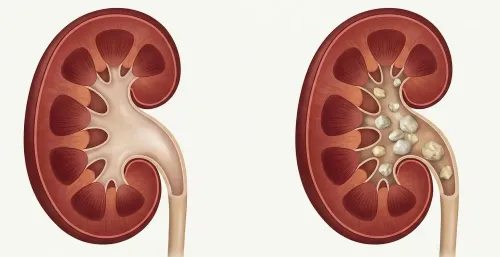
Severe, cramping flank pain that comes in waves and travels towards the groin is more characteristic of a kidney stone. Kidney stone pain versus kidney cancer is not a diagnosis, however: kidney cancer flank pain is more often a persistent dull ache below the ribs or in the side.
Muscle strain, urinary-tract infection, cystitis, prostatitis and benign kidney cysts are more common explanations.
| Pattern | More consistent with | Important limitation |
|---|---|---|
| Sudden, severe pain in waves, moving towards the groin | Kidney stone | Infection, obstruction and other conditions can cause severe pain |
| Persistent dull ache below the ribs or in the side | Kidney cancer or another urinary or musculoskeletal problem | Persistent dull kidney pain is nonspecific and does not identify cancer |
| Pain after lifting, twisting or movement | Muscle strain | Pain patterns overlap, so movement-related pain does not exclude urinary disease |
Arrange medical assessment if pain persists, recurs or occurs with haematuria, even if it improves between episodes. Use this checklist:
- Report visible blood in the urine, including pink, red or cola-coloured urine.
- Seek prompt examination for an unexplained lump or swelling in the abdomen or flank. A kidney cancer lump is not an early screening sign; a palpable kidney mass usually reflects a larger lesion.
- Do not wait for pain, bleeding and a lump to appear together. These findings are uncommon as a complete combination, and early kidney cancer can cause no symptoms.
- Avoid home diagnosis based on pain alone; examination, urine tests and appropriate imaging identify the cause.
Which other findings raise concern, and who has a lower threshold for review?
Persistent fever without an obvious infection, drenching night sweats, marked fatigue, unexplained anaemia, reduced appetite, nausea and weight loss are nonspecific. They do not prove cancer, but concern rises when they persist or occur with haematuria, flank pain, abnormal kidney-function results or abnormal imaging.
The phrases kidney cancer fatigue anaemia and kidney cancer night sweats describe concerns, not diagnoses.
| Finding | What it may suggest | Important limitation |
|---|---|---|
| Swollen lymph nodes | More advanced disease | Not a reliable early screening sign |
| Bone pain | Possible spread or another bone disorder | Not a reliable early screening sign |
| Persistent cough | Possible chest involvement or a common respiratory illness | Not a reliable early screening sign |
Blood tests can show high calcium, high blood pressure or excess red blood cells as possible paraneoplastic effects. Each also has many non-cancer causes, so the result needs medical interpretation.
Lower your threshold for review if you have:
- Smoking
- Obesity
- High blood pressure
- Long-term dialysis
- A close family history of kidney cancer
- von Hippel-Lindau disease, including von Hippel-Lindau kidney cancer risk
- Hereditary leiomyomatosis and renal cell cancer syndrome, known as HLRCC
A risk factor is not a diagnosis and does not mean you need routine imaging. Your symptoms and individual medical history determine the next step; persistent or combined findings deserve assessment rather than self-diagnosis.
What happens after a warning sign is reported?
Visible blood in the urine deserves prompt assessment after one episode, even when it is painless or disappears the next day. A clinician will take your history, examine you and check whether medicines, infection, stones or another condition could explain the bleeding.
These kidney cancer diagnosis tests commonly form the initial checklist:
- Urine testing checks for red blood cells and signs of urinary infection.
- A complete blood count looks for anaemia.
- Kidney-function tests measure how well the kidneys are filtering; calcium and selected blood tests may identify abnormalities that need explanation.
- Imaging may start with a renal ultrasound. CT with contrast or MRI may follow, depending on kidney function, the suspected cause and what the first scan shows.
- Urological assessment is appropriate for persistent or unexplained visible haematuria, a kidney mass, a new flank or abdominal lump, or symptoms combined with abnormal test results.
The phrase kidney ultrasound CT MRI describes different tools, not interchangeable tests. Imaging helps distinguish infection, stones, simple cysts and a suspicious renal lesion; kidney mass evaluation may then involve specialist imaging, biopsy advice or surgical assessment. A urologist for blood in urine can coordinate these decisions.
Dr Zaffar Sayed Urologist can help organise that pathway when the cause remains unclear.
Do not rely on watchful waiting. Report visible blood promptly, and seek medical review for persistent unexplained urinary or systemic symptoms, including fatigue, fever or weight loss, even if they improve temporarily.
Related service
Uro-Oncological Management Urologic oncology is the field of medicine concerned with the research and treatment of cancers of the urinary system for both genders, as well as... View service → |
Frequently asked questions
Which symptoms can signal kidney cancer?
Visible blood in the urine is a key warning sign. Other findings can include persistent pain in the side or lower back, an abdominal lump, unexplained weight loss, fatigue, fever, night sweats, or loss of appetite.
When does blood in the urine need prompt assessment?
Arrange prompt medical assessment for visible blood in the urine, even if it appears once, causes no pain, or disappears within a day. Do not assume that painless or short-lived bleeding is harmless.
How can kidney cancer pain be confused with stones or muscle strain?
Kidney cancer pain is often persistent, dull, or located in the side or lower back. Kidney stones more often cause sudden, severe, wave-like pain, while muscle strain usually follows movement or lifting and improves with rest.
Which other findings raise concern about kidney cancer?
Unexplained weight loss, ongoing fatigue, fever without a clear infection, night sweats, reduced appetite, a persistent abdominal or side lump, and recurrent urinary symptoms raise concern, especially alongside blood in the urine.
What happens after a kidney cancer warning sign is reported?
A clinician may take your medical history, examine you, request urine and blood tests, and arrange imaging such as an ultrasound or CT scan. A urologist reviews concerning results and decides whether further testing is needed.